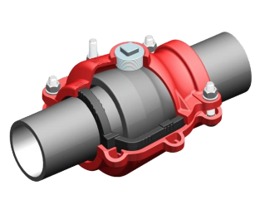
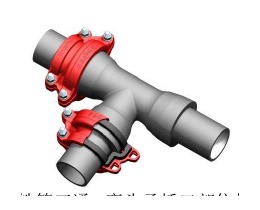
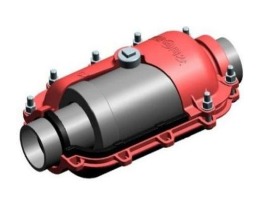
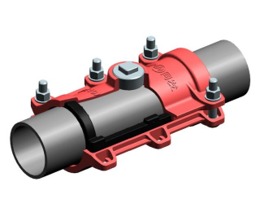
Walk into any water utility’s maintenance yard and you’ll find a bin of couplings — sleeve-type connectors, split-sleeve clamps, flanged adapters, and probably a few fittings that nobody is quite sure about. The confusion is understandable: repair clamps and universal couplings look superficially similar (both wrap around a pipe, both use rubber gaskets), but they solve fundamentally different problems and should not be substituted for each other.
This guide draws a precise line between the two product families, explains the engineering logic behind each, and walks through the selection criteria for the most common field scenarios.
The fundamental difference: containment vs. connection
Repair clamps are containment devices. They grip the outside of a pipe that is already continuous and seal a defect (crack, hole, corroded section, or failed joint) in the pipe wall. The pipe itself is the structural member; the clamp is the seal.
Universal couplings (also called universal connectors, multi-joint couplings, or flexible couplings) are connection devices. They join two pipe ends — bridging a gap between the ends, accommodating different outside diameters or different materials, and providing some angular and longitudinal flexibility. The coupling is the structural joint.
This distinction matters enormously in the field:
- A repair clamp over a completely rotted-through section of pipe barrel will appear to seal the leak but will not restore the pipe’s structural integrity. The wall will continue to deteriorate inside the clamp.
- A universal coupling applied between two pipe sections that both have intact, sound pipe walls will make a durable, flexible joint — but it provides no repair function to the pipe itself.
Repair clamps: what they do and when to use them
A split-sleeve repair clamp consists of:
- A two-piece (or multi-piece, for large DN) ductile iron or stainless steel outer shell
- An EPDM or NBR rubber gasket, continuous around the pipe’s circumference
- Bolts that draw the shell halves together and compress the gasket against the pipe OD
When tightened, the compressed gasket creates a circumferential seal against the pipe surface. The seal holds the internal pressure load; the shell holds the gasket in compression.
Correct applications for repair clamps
Barrel cracks and pinholes: A longitudinal crack in the pipe barrel, or a corrosion pinhole, is the primary use case. The clamp straddles the defect; the gasket seals over it. The pipe on both sides of the defect remains intact and structural.
Circumferential bell-and-spigot joint failure: The rubber ring at a bell-and-spigot joint has deteriorated or the joint has separated slightly. A socket repair clamp with a profiled gasket wraps around the entire joint zone, re-establishing the seal. (Note: if the joint has pulled apart more than the design pull-out distance, this application is borderline — you need to assess whether the joint can be re-pushed before the clamp is applied.)
Small area of external corrosion with confirmed intact bore: An inspection shows 3–4 corroded pinholes in a 150 × 150 mm area. Wall thickness gauging confirms the remaining wall is structurally adequate. A sleeve repair clamp with appropriate sleeve length covers all the defects in one installation.
When repair clamps are the wrong choice
- When you need to join two separate pipe sections: A repair clamp has no provision for end seals — it seals the OD of a continuous pipe, not pipe ends facing each other. If you cut out a damaged section, you need a coupling, not a clamp.
- When the pipe wall is structurally compromised over a long run: A clamp does not reinforce the pipe. If the wall has lost more than 50% of its original thickness over 500 mm of length, you need a sleeve liner or pipe replacement.
- On pipes with active transverse movement: If the ground is settling and the pipe is being pulled apart at joints, a rigid clamp will be worked loose. Use a flexible coupling designed for axial movement.
Universal couplings: what they do and when to use them
A universal coupling joins two pipe ends. It typically consists of:
- A central sleeve (the body), which surrounds the pipe gap
- End seals — usually EPDM lip seals or full-face gaskets — that compress against the pipe ODs at each end
- A housing that can be bolted into a rigid assembly or left as a flexible mechanical joint
- Grippers or toothed rings in some designs that resist axial pull-out
The key capability that defines a “universal” coupling is OD accommodation. A standard coupling is designed for a single pipe OD. A universal coupling is designed with a wider gasket and housing that accommodates a range of ODs at each end — typically ±5–10 mm variation from a nominal OD, and sometimes with deliberately different OD ranges at each end (which is how it can join old grey cast iron to new ductile iron, or ductile iron to HDPE).
Correct applications for universal couplings
Pipe section replacement: You excavate and cut out 3 metres of corroded steel main. The new replacement section is cut to length. A universal coupling at each end joins the replacement section to the existing pipe, allowing for minor misalignment and OD variation.
Cross-material transitions: Old grey cast iron mains typically have an OD that does not match modern ductile iron of the same nominal diameter. A universal coupling accommodates both ODs simultaneously — no pipe machining required. This is the correct tool for upgrading a system incrementally, section by section.
Reducing connections: A universal reducing coupling joins two pipes of different nominal diameters. Common in HVAC and industrial applications; used in water distribution for off-network yard connections.
Thrust restraint required: In high-pressure systems with long straight runs or directional changes, the pressure end-load on a mechanical coupling can be substantial. Restrained universal couplings (with toothed gripping rings) resist pull-out. Standard repair clamps have no pull-out resistance because they are not designed to be end fittings.
Accommodating thermal expansion: Universal couplings designed with flexible end seals allow the coupled pipes to move axially within the coupling sleeve. This is essential for above-ground pipelines exposed to large temperature swings.
When universal couplings are the wrong choice
- Over a mid-barrel crack: A universal coupling’s seals sit at the pipe ends; there is no seal covering the centre of the pipe. Placing a coupling over a cracked section provides no seal.
- When the pipe ends are not square-cut: Universal couplings work best when both pipe ends are cut perpendicular to the pipe axis. A pipe end cut at an angle creates an uneven gasket-to-pipe contact that can leak under pressure cycling. Square-cut the pipe before installing the coupling.
- When angular deflection is extreme: Universal couplings accommodate a few degrees of angular misalignment (typically 3–8 degrees depending on design). They are not swivel joints.
The double-sleeve clamp: when you need elements of both
A product that often creates confusion is the double-socket connector (also called a double-ended coupling or double-sleeve repair coupling). This fitting has gasket seals at both ends — and a blank central section — so it can:
- Be positioned over a cut-out section of pipe, bridging the gap between two pipe ends (like a universal coupling), and
- Provide a seal against the OD of each pipe end within a defined OD range (like a repair clamp)
The double-socket connector is the correct tool when:
- You are cutting out a short, corroded section (typically 150–500 mm) and want a single fitting rather than two separate couplings plus a spool piece
- The pipe ODs on both sides are slightly different (common when one side has been repaired before, or when you’re joining to a replacement pipe with a different-spec coating)
- You need some axial movement capability at both ends
The limitation: double-socket connectors do not reinforce the pipe wall between the two ends. They bridge the gap. If the section being replaced is longer than the coupling’s maximum accommodation length, you still need a spool piece.
Specification comparison table
| Feature | Repair Clamp | Universal Coupling | Double-Socket Connector |
|---|---|---|---|
| Seals a crack or pinhole | ✓ | ✗ | ✗ |
| Joins two pipe ends | ✗ | ✓ | ✓ |
| Handles OD variation | Limited (OD range) | ✓ (wide range) | ✓ |
| Cross-material transition | ✗ | ✓ | ✓ |
| Axial movement | ✗ | ✓ (flexible types) | ✓ |
| Pull-out restraint | ✗ | ✓ (restrained types) | Partial |
| Flanged-end option | No | Yes | Yes |
| Typical application | Leak repair | Section replacement / transition | Short-section replacement |
OD range: the most common source of ordering errors
Both product families require accurate OD measurement. The most common ordering error is specifying by DN (nominal diameter) without confirming the actual OD. Here is why this matters:
For DN300:
- Modern ductile iron (EN 545 / ISO 2531): OD = 326 mm
- Old grey cast iron (BS 78 / older ISO): OD = 322–338 mm (varies by foundry and era)
- Steel (carbon steel pipe): OD = 323.9 mm (per API 5L / ISO 3183)
- HDPE (SDR 17): OD = 315 mm (the SDR OD spec, not the iron OD)
A universal coupling ordered as “DN300” will fit modern ductile iron but may not fit an old grey cast iron main with OD 334 mm — depending on the specific model’s accommodation range. Always provide the measured OD (use a circumference tape) when ordering couplings for existing pipework.
When you need both on the same project
Complex repair projects often use both products simultaneously. A typical case: a 10-metre section of DN400 grey cast iron water main has severe corrosion with five distinct defects — two pinholes in the barrel, two failed bell joints, and one cracked collar.
The efficient solution:
- Two socket repair clamps on the failed bell joints
- One wide-body sleeve repair clamp covering both barrel pinholes (if within ~600 mm of each other)
- One universal coupling at the cracked collar, joined to a short DI spool piece, with a second universal coupling rejoining the spool to the original pipe
This avoids a full section replacement that would require road cutting, traffic management, and significant disruption — and it keeps the main live throughout, using repair clamps for the pinholes and joints while the one unavoidable cut (the cracked collar, too large to clamp) is handled with a spool piece.
PipeKnot supplies the complete product range: split-sleeve repair clamps for ductile iron, grey cast iron, and steel from DN40 to DN2000; universal connectors accommodating multiple OD ranges; double-socket connectors for section replacement; and flanged expansion joints for thermal movement applications. Send us your pipe OD, operating pressure, defect description, and desired pressure rating and we will specify the right product for each repair point in your project.