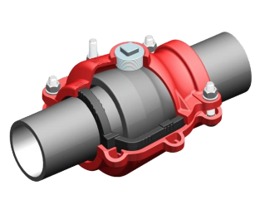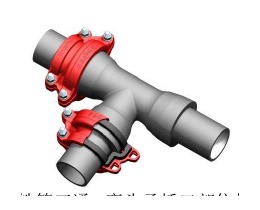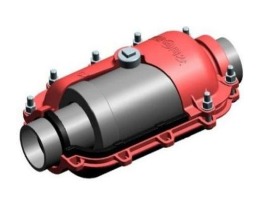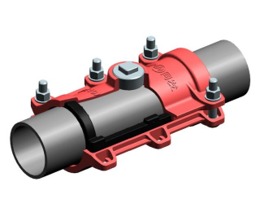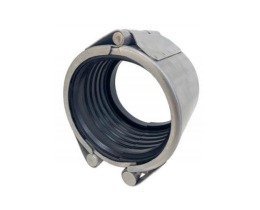
Two repair clamps arrive on site. Both are stainless steel. Both have the same bolt pattern, the same EPDM gasket, the same black finish from the passivation bath. The procurement team ordered one for a coastal desalination intake — and ordered the wrong grade. Six months later, pitting corrosion has undermined the gasket seat and the clamp needs to be replaced.
The difference between SS304 and SS316 is invisible to the eye. But it is decisive in any environment containing chlorides — seawater, brackish water, marine atmosphere, desalination process streams, or heavily chlorinated potable water systems. This post gives you the metallurgy to make the right call, the environments where each grade belongs, and the procurement questions that protect you from receiving the wrong material.
Metallurgy: what separates 304 from 316
Both SS304 (UNS S30400) and SS316 (UNS S31600) are austenitic stainless steels. Both contain 16–18% chromium, which forms the chromium-oxide passive layer that gives stainless its corrosion resistance. Both are non-magnetic in the annealed condition (though cold-worked parts may show slight magnetism). Both are readily weldable.
The key difference is molybdenum:
| Property | SS304 | SS316 |
|---|---|---|
| Chromium | 18–20% | 16–18% |
| Nickel | 8–10.5% | 10–14% |
| Molybdenum | 0% (trace) | 2–3% |
| Carbon (max) | 0.08% | 0.08% |
| Manganese (max) | 2.0% | 2.0% |
| PRE (pitting resistance equiv.) | ~18–19 | ~25–26 |
The molybdenum addition in SS316 does two things:
- It strengthens the passive oxide layer specifically against chloride ion attack. Chlorides disrupt the passive film on stainless steel, initiating pitting corrosion. Molybdenum makes the passive film more resistant to this disruption.
- It raises the Pitting Resistance Equivalent (PRE = %Cr + 3.3×%Mo + 16×%N). A PRE of 25+ is the threshold typically specified for seawater service. SS304 at PRE ~18 falls well below that; SS316 at PRE ~26 is right at or above it depending on the heat.
The practical consequence: in a chloride environment, SS304 develops pitting corrosion — isolated deep pits that penetrate faster than general corrosion, that are difficult to detect until the pit reaches critical depth, and that occur preferentially at crevices (which is exactly where repair clamp gaskets and bolt heads sit).
Corrosion resistance comparison
The standard test for chloride pitting resistance is the critical pitting temperature (CPT) in 6% FeCl₃ solution:
| Grade | CPT (6% FeCl₃) | Notes |
|---|---|---|
| SS304 | ~15°C | Pits readily at room temperature in this test |
| SS316 | ~35°C | Significantly better but still limited |
| SS316L | ~35°C | Similar to 316; lower carbon = better weld heat-affected zone |
| Duplex 2205 | ~>70°C | For severe seawater service |
In practical terms: SS316 can handle intermittent chloride exposure, marine atmosphere, and process streams with moderate chloride content. It is not immune to pitting — it is more resistant than 304. For full seawater immersion in warm water (above 25°C), duplex stainless or higher-grade alloys should be considered.
Environments where SS316 is mandatory
Direct seawater contact: Any repair clamp in a seawater intake, outfall, or desalination process stream should be SS316 minimum. Seawater chloride concentration is approximately 19,400 mg/L — far above the threshold where SS304 pitting becomes aggressive. At the temperatures typical of desalination (ambient to 40°C at the feed stage), pitting corrosion on SS304 proceeds rapidly. Clamps on seawater mains that are specified as “stainless steel” without grade qualification have repeatedly been found to be SS304 — and have failed within 2–5 years.
Coastal and marine atmosphere: Airborne chloride deposition from the sea settles on exposed clamps, concentrates at crevices, and initiates pitting even without direct water contact. Within 500 m of the coast, all exposed or buried stainless components should be SS316. Beyond 5 km, SS304 is generally adequate.
Brackish water systems: Inland brackish groundwater, estuarine distribution, and agricultural recycled water systems can reach 1,000–10,000 mg/L chloride. In this range, SS316 is the safer specification. SS304 may survive in the lower part of this range, but without water chemistry analysis specific to the site, the conservative choice is SS316.
Chlorinated potable water with high residuals: Treatment plants maintaining chloramine residuals above 4 mg/L, or systems using sodium hypochlorite dosing, expose in-contact fittings to oxidizing chlorine species that are more aggressive than simple chloride ions. SS316 handles this more reliably.
Desalination plant piping: Both the intake (seawater) and the brine reject side of a SWRO plant are severely corrosive. Product water side is less aggressive but chloride breakthrough can occur. Specify SS316 throughout a desalination facility.
Chemical process streams with chloride contamination: Hydrochloric acid (HCl), ferric chloride, calcium chloride, and many industrial chloride salts are beyond what either 304 or 316 can reliably handle. For HCl concentrations above trace levels, neither austenitic grade is suitable — move to higher-nickel alloys or non-metallic solutions.
Environments where SS304 is adequate
Inland freshwater distribution (pH 6.5–8.5): Treated municipal water with chloride content below 250 mg/L is not aggressive enough to drive pitting on SS304. The passive film holds. SS304 repair clamps in this service have 30+ year service records.
Natural gas distribution: Gas lines contain no free water at operating conditions (gas is dehydrated upstream). The corrosion mechanism is absent. SS304 is appropriate and more cost-effective than SS316 for gas-service clamps where stainless is specified.
Neutral wastewater, no chlorides: Industrial wastewater from food processing, neutral pH, low TDS — SS304 is adequate. If the waste stream contains chlorinated cleaning products, revisit.
Indoor HVAC and process water: Closed-loop heating and cooling systems with treated water (pH controlled, corrosion inhibitors dosed) are benign. SS304 is the standard specification for these systems.
Freshwater fire protection systems: Sprinkler systems operating on municipal freshwater are not a chloride risk. SS304 is used widely in this application.
Cold environments where pitting kinetics are slow: Pitting corrosion is temperature-dependent. In consistently cold systems (below 10°C, not cycled), the practical difference between SS304 and SS316 in moderate-chloride environments narrows. For above-ambient service, the grade selection matters more.
Cost difference
SS316 carries a consistent cost premium over SS304. The premium reflects the nickel and molybdenum content — both are more expensive commodities than iron and chromium.
For repair clamps, typical premium is 30–50% on the clamp body cost. For a DN200 stainless repair clamp:
- SS304 body: approximately $280–$380 ex-works
- SS316 body: approximately $400–$550 ex-works
At volume, the premium may compress to 25–30%. It does not go away, because the raw material input cost difference is real.
The 30–50% premium is the correct number to use in engineering cost estimates. If a supplier quotes SS316 at the same price as SS304, request the material certificate before accepting — price convergence is a red flag for material substitution.
On a project where 50 clamps are needed in a seawater intake application, the additional cost for SS316 over SS304 is approximately $6,000–$8,000 on a $20,000+ clamp budget. That is not the number that drives project economics. The cost of replacing failed SS304 clamps within 3–5 years — including excavation, labour, production interruption, and replacement fittings — is a larger number by a wide margin.
Pitting and crevice corrosion in clamp design
Crevice corrosion is the more insidious risk on repair clamps. Unlike pitting on an open surface, crevice corrosion occurs in the stagnant, low-oxygen zones under gaskets, between flange faces, and under bolt heads — exactly the geometry of a repair clamp installation.
In a crevice, the local chemistry shifts as chlorides concentrate and pH drops. The passive film breaks down even on SS316 in severe enough crevice conditions. Design factors that reduce crevice corrosion risk:
- Minimize crevice gap: tight-fitting gaskets with low compressibility leave smaller stagnant zones than loose-fit gaskets.
- Avoid galvanic couples in the crevice: mixed metals in contact (see galvanic corrosion section below) accelerate crevice attack.
- Surface finish: 2B (mill) finish or electropolished finish reduces surface roughness where chlorides can nucleate. Rough machined surfaces are more vulnerable.
- Drainage orientation: crevices that drain or flush are less aggressive than those that retain stagnant liquid. Installation orientation matters where practical.
When specifying SS316 clamps for seawater service, confirm with the supplier that the bolt material is also SS316 (or a higher grade such as SS316L, A4-70 per ISO 3506). A SS316 band body with SS304 bolts is a mixed-metal system where the bolts — at the most crevice-prone location — are the weaker component.
Galvanic corrosion when mating with ductile iron pipe
A stainless steel repair clamp installed on a ductile iron (DI) pipe creates a galvanic couple. In the galvanic series:
- DI/grey cast iron: more anodic (corrodes preferentially)
- SS304/SS316: more cathodic (protected)
In a galvanic couple, the anode corrodes faster than it would in isolation. The stainless clamp accelerates corrosion of the adjacent DI pipe at the contact zone.
In standard buried service with neutral, low-conductivity soil, this effect is minor because soil resistivity limits current flow. In seawater, brackish water, or electrolyte-rich groundwater — where conductivity is high — galvanic corrosion of the DI pipe at the clamp interface can be significant.
Mitigation options:
- Isolation gasket: use a non-conductive gasket material between the stainless clamp body and the pipe surface. Standard EPDM gaskets provide some isolation; a dedicated electrical isolation gasket provides complete isolation.
- Cathodic protection: if the overall pipeline has CP coverage, the galvanic couple at the clamp is managed by the CP system.
- Coating continuity: if the DI pipe is epoxy-coated, confirm the coating is intact at the clamp contact area. The coating breaks the galvanic circuit.
For inland freshwater and neutral soil conditions, the galvanic effect is generally manageable and does not drive clamp material selection. For seawater and high-conductivity environments, isolate or specify the DI pipe surface protection explicitly.
Procurement guidance: requesting material certificates
“Stainless steel” without grade qualification is not a useful specification. SS201, SS202, SS301, SS304, SS316, and SS316L are all “stainless steel” but span a wide range of corrosion performance. The specification should read:
Body material: AISI 316 / UNS S31600, certified to ASTM A276 or equivalent, mill certificate required.
When receiving material certificates (also called mill test reports or MTRs), verify:
- The heat number on the certificate matches the heat number stamped or tagged on the clamp
- Molybdenum content is listed as 2.0–3.0% (not simply “stainless” or “SS316”)
- Certificate is from the steel mill, not from a distributor or fabricator (downstream certificates are less reliable)
- Certificate is specific to the product lot you received — not a generic document
For critical applications (seawater, chemical service, high-pressure systems), request third-party PMI (positive material identification) testing on a sample from the received lot. A handheld XRF analyser reads the alloy composition in seconds and confirms that SS316 is what was received. PMI is standard practice on offshore and petrochemical projects; it is underused in municipal infrastructure procurement.
Common failure mode: a stainless repair clamp is specified as SS316 in the purchase order. The supplier quotes and ships SS304, which is visually identical. The material certificate is missing or is a generic document not tied to the specific heat. Six months into a seawater intake application, pitting begins. PMI during incoming inspection would have caught the substitution.
Selection summary
| Application | Recommended grade | Notes |
|---|---|---|
| Seawater intake / outfall | SS316 minimum; consider duplex | Full immersion in high-chloride, warm water |
| Coastal installation (within 500 m of coast) | SS316 | Marine atmosphere chloride exposure |
| Desalination plant piping | SS316 | Both feed and brine reject sides |
| Brackish water (>1,000 mg/L Cl⁻) | SS316 | Site-specific water chemistry should confirm |
| Potable water, inland, pH 6.5–8.5, <250 mg/L Cl⁻ | SS304 | Standard municipal distribution |
| Natural gas distribution | SS304 | No liquid water contact at operating conditions |
| HVAC closed-loop | SS304 | Treated water, controlled chemistry |
| Industrial wastewater, neutral, no chlorides | SS304 | Confirm no chlorinated cleaning products |
| Chlorinated water treatment (high dosing) | SS316 | Oxidizing chlorine species more aggressive than chloride |
| Fire protection (freshwater) | SS304 | Standard specification |