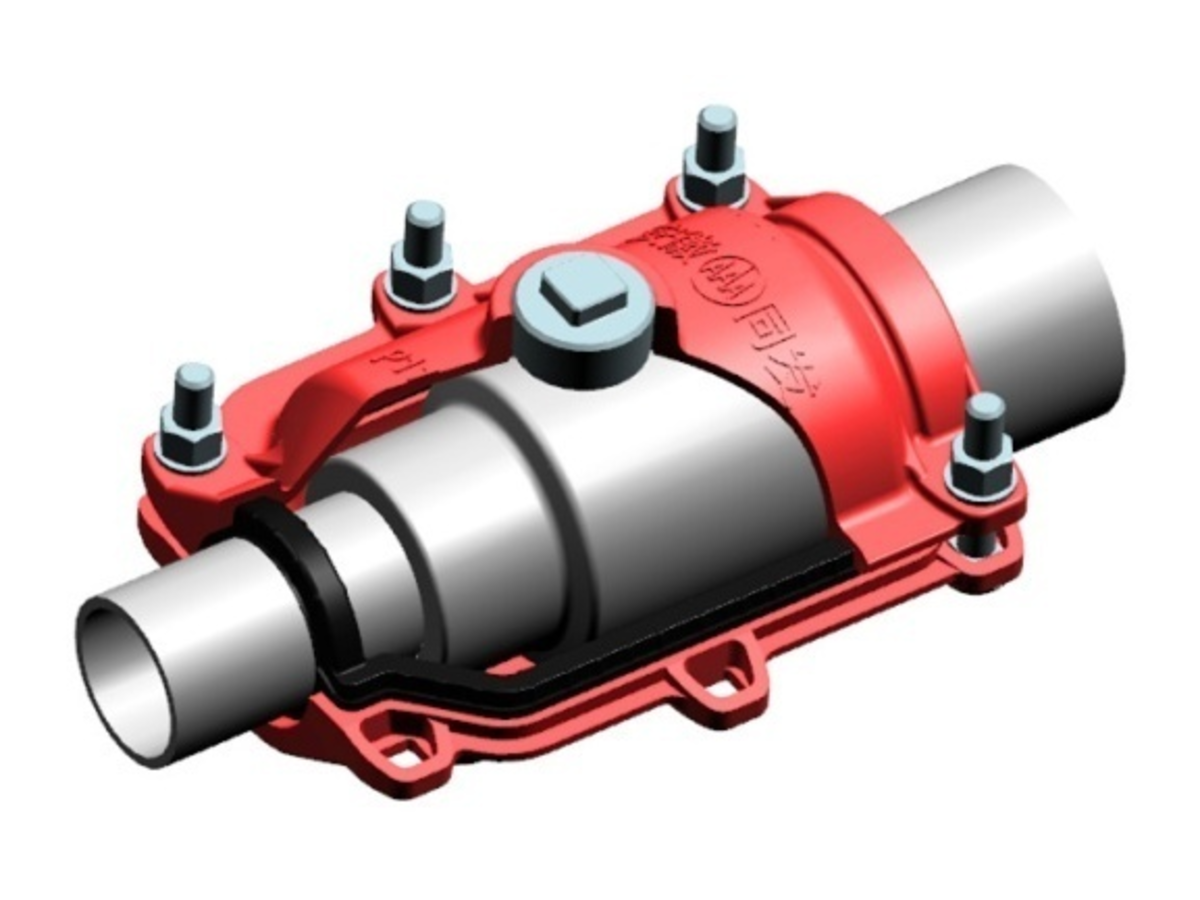
Ordering a repair clamp by DN alone is the single most common sizing mistake in pipeline repair procurement. DN is a nominal label — a sizing shorthand — not a physical dimension. Two pipes both called DN200 can have outer diameters 10 mm apart depending on material, wall class, and manufacturing standard. Clamps seal against actual OD. If you specify only the DN and skip the measurement, you have roughly a 30–40% chance of receiving a clamp that won’t close correctly on the pipe you have.
This guide covers how DN relates to real pipe dimensions, how to measure correctly, how different pipe materials complicate the picture, and how to build an RFQ that eliminates sizing errors.
What DN actually means
DN (Diameter Nominal) is a dimensionless designation system defined in ISO 6708. It is not a diameter in millimetres. It’s a reference number used to group pipe and fittings that are intended to connect to each other — nothing more.
The actual OD corresponding to a given DN depends on the pipe material and the applicable standard:
| DN | Ductile iron (ISO 2531) OD | Steel (ISO 4200) OD | PE100 (ISO 4427) OD | PVC-U (ISO 1452) OD | Concrete (typical) OD |
|---|---|---|---|---|---|
| DN40 | 56 mm | 48.3 mm | 50 mm | 50 mm | — |
| DN50 | 66 mm | 60.3 mm | 63 mm | 63 mm | — |
| DN80 | 98 mm | 88.9 mm | 90 mm | 90 mm | — |
| DN100 | 118 mm | 114.3 mm | 110 mm | 110 mm | 120 mm |
| DN150 | 170 mm | 168.3 mm | 160 mm | 160 mm | 175 mm |
| DN200 | 222 mm | 219.1 mm | 200 mm | 200 mm | 230 mm |
| DN300 | 326 mm | 323.9 mm | 315 mm | 315 mm | 340 mm |
| DN400 | 429 mm | 406.4 mm | 400 mm | 400 mm | 450 mm |
| DN500 | 532 mm | 508.0 mm | 500 mm | 500 mm | 555 mm |
| DN600 | 635 mm | 610.0 mm | 630 mm | 630 mm | 660 mm |
| DN800 | 842 mm | 813.0 mm | 800 mm | — | 870 mm |
| DN1000 | 1048 mm | 1016 mm | 1000 mm | — | 1080 mm |
Note the spread on DN100 alone: 110 mm (PE/PVC), 114.3 mm (steel), 118 mm (DI), and 120 mm (concrete). That’s a 10 mm range. A clamp for DI DN100 will not seal on PE DN100 pipe without modification.
How to measure pipe OD in the field
The correct tool is an OD tape (also called a circumferential tape or pi tape). It wraps around the pipe and reads OD directly from the circumference-to-diameter conversion. Use calipers for pipes below DN200. For large-diameter pipes (DN600 and above) in a trench, use a flexible OD tape or measure the circumference with a standard tape and divide by π.
Measurement protocol:
- Measure at a clean, undamaged section of pipe, not at the crack or corrosion zone
- Take two measurements 90 degrees apart (at 12 o’clock and 3 o’clock positions) — pipes are rarely perfectly round, especially buried PE
- Record both; the clamp must accommodate the larger reading
- Note any ovality — if the two readings differ by more than 2% of nominal OD, flag it in the RFQ; the clamp manufacturer needs to know
- Remove scale, concrete encasement residue, and bitumen coating before measuring; coating thickness adds to effective OD
Tolerance bands by material
Repair clamps are manufactured to span a range of ODs, not a single value. A clamp listed as “DN300 / 315–340 mm” closes tightly across that OD range. Outside the range, the clamp either can’t close or over-expands the gasket.
Understanding why tolerance bands vary by material helps you spec correctly:
Ductile iron pipe (per ISO 2531 / EN 545): Cast surface, defined OD tolerance of ±1.5 mm for DN80–DN400, ±2.0 mm for DN500–DN1000. Consistent enough that tolerance bands are tight. A DN200 DI pipe runs 222 ±1.5 mm — the clamp band needs to cover roughly 219–225 mm.
Steel pipe (per ISO 4200 / EN 10220): Tighter OD tolerance than DI for seamless pipe (±0.5% OD), but ERW pipe can have ±1% OD. Coating systems (FBE, 3LPE) add 2–5 mm to effective diameter. Always measure over the coating.
PE pipe (per ISO 4427 / EN 12201): OD is controlled to ±0.4–0.7% depending on SDR. PE pipes also ovalize under soil loading — buried PE in soft soil can ovalize 3–5% of nominal OD before failing. Specify clamps with wider OD range for PE to accommodate ovality.
PVC-U pipe (per ISO 1452 / EN 1452): Similar OD tolerance to PE but less prone to ovality due to higher stiffness. Standard tolerance ±0.5% for DN up to DN315; ±0.7% for DN400 and above.
Concrete pipe (BSEN 1916 or national standards): Greatest variability. Outer diameter depends on wall thickness, which varies by pressure class. A DN300 pre-stressed concrete pipe can range from 440 mm to 520 mm OD depending on class. Always get the pipe drawing or measure directly — never order a concrete pipe clamp by DN alone.
Clamp series and DN range coverage
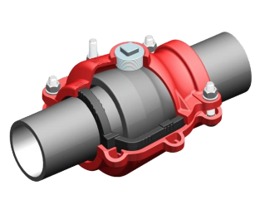
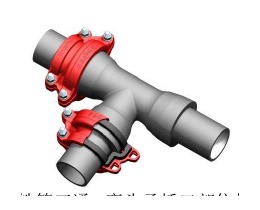
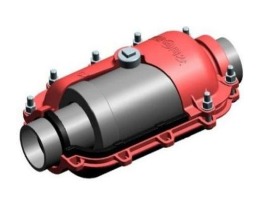
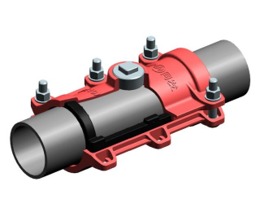
PipeKnot (supplied by Anhui Tongfa) covers the full DN40 to DN2000 range across several series:
| Clamp series | DN range | OD range | Pressure rating | Primary pipe material |
|---|---|---|---|---|
| Straight repair clamp (DI) | DN40–DN2000 | 56–2060 mm | 1.0 / 1.6 MPa | Ductile iron, grey iron |
| Socket repair clamp (DI) | DN80–DN1600 | 98–1642 mm | 1.0 / 1.6 MPa | Ductile iron |
| Sleeve repair clamp (DI) | DN80–DN1200 | 98–1240 mm | 1.0 MPa | Ductile iron |
| Straight repair clamp (plastic) | DN40–DN1200 | 50–1200 mm | 0.6 / 1.0 MPa | PE, PVC, PPR |
| Socket repair clamp (plastic) | DN40–DN1000 | 50–1000 mm | 0.6 / 1.0 MPa | PE, PVC, PPR |
| Concrete pipe repair clamp | DN100–DN2000 | 120–2050 mm | 0.6 MPa | Pre-stressed concrete |
| Stainless steel repair clamp | DN40–DN600 | 48–640 mm | 1.6 / 2.5 MPa | All pipe materials |
The DN2000 upper limit on concrete and the full-range DI straight clamp covers essentially all municipal distribution and transmission infrastructure. For DN above DN2000, contact us — Anhui Tongfa has manufactured custom clamps up to DN2600 for large transmission mains, but these are project-engineered items with 6–10 week lead times.
Shell length selection
Beyond OD range, clamp length (the dimension along the pipe axis) must cover the damaged zone with margin. Typical guidance:
- Cracks, pinholes, corrosion pits: clamp length = damage length + 100 mm each side (200 mm total margin)
- Split joints or full-circumference cracks: use a long-body clamp or two adjacent clamps with 50 mm gap
- Heavily corroded sections longer than 400 mm: use two overlapping clamps rather than one oversized unit; this prevents gasket span issues
Standard stock lengths for straight clamps: 150 mm, 200 mm, 300 mm, 400 mm, 500 mm. Non-standard lengths are available but add 10–15 working days.
Sizing table: DN to clamp OD band (DI pipe, ISO 2531)
This is the table to put in front of your procurement team:
| DN | Pipe OD (nominal) | OD tolerance | Clamp OD band to specify |
|---|---|---|---|
| DN40 | 56 mm | ±1.0 mm | 54–60 mm |
| DN50 | 66 mm | ±1.0 mm | 64–70 mm |
| DN80 | 98 mm | ±1.0 mm | 95–103 mm |
| DN100 | 118 mm | ±1.5 mm | 115–125 mm |
| DN150 | 170 mm | ±1.5 mm | 166–176 mm |
| DN200 | 222 mm | ±1.5 mm | 218–228 mm |
| DN250 | 274 mm | ±1.5 mm | 270–280 mm |
| DN300 | 326 mm | ±1.5 mm | 322–332 mm |
| DN400 | 429 mm | ±2.0 mm | 424–436 mm |
| DN500 | 532 mm | ±2.0 mm | 526–540 mm |
| DN600 | 635 mm | ±2.0 mm | 628–644 mm |
| DN700 | 738 mm | ±2.5 mm | 730–748 mm |
| DN800 | 842 mm | ±2.5 mm | 834–852 mm |
| DN900 | 945 mm | ±3.0 mm | 936–956 mm |
| DN1000 | 1048 mm | ±3.0 mm | 1038–1058 mm |
| DN1200 | 1255 mm | ±4.0 mm | 1244–1266 mm |
| DN1400 | 1462 mm | ±5.0 mm | 1450–1474 mm |
| DN1600 | 1668 mm | ±6.0 mm | 1654–1682 mm |
| DN2000 | 2080 mm | ±8.0 mm | 2064–2096 mm |
For pipe materials other than DI, replace the OD values with the actual pipe standard values and add any coating thickness.
Common sizing mistakes
1. Ordering by DN without measuring. This produces the OD mismatch described above. On DI pipe it usually results in a clamp that’s slightly too small or too large and leaks within a few pressure cycles. On concrete pipe it almost always fails — concrete OD variability is too high for DN-only ordering.
2. Forgetting coating thickness. A DN300 DI pipe with 3LPE coating can be 6–10 mm larger in OD than a bare pipe. Clamp must close over the coating, not into it. If the coating is thick, either specify a larger OD band or strip the coating locally under the clamp (only if the pipe will be recoated).
3. Specifying DN instead of OD range on the purchase order. The clamp manufacturer interprets DN relative to their own table. Two manufacturers’ “DN200” clamps may span different OD ranges. Always state the OD range in mm explicitly on the PO.
4. Using a DI clamp on PE pipe. The OD is different (118 mm vs 110 mm for DN100), the gasket profile doesn’t match the plastic surface, and the pressure band is wrong. These are different products.
5. Ignoring ovality on large-diameter PE. A DN800 PE pipe buried in soft clay can measure 795 mm at 12 o’clock and 810 mm at 3 o’clock. A clamp specified for 800 mm OD may not close on the 810 mm axis. Specify a wider band or request an oval-bore clamp for large PE above DN400.
6. Mixing up OD standards for plastic pipe. ISO 4427 and GB/T 13663 specify different OD tables for PE pipe at the same DN. A DN110 PE100 pipe per ISO is 110 mm OD; some Chinese specifications run DN110 at 114 mm. If the pipe was imported from a different country, verify which standard governs it before ordering the clamp.
How to send a proper RFQ
An RFQ that includes the following information eliminates back-and-forth and gets you an accurate quote within one business day:
Pipe material: [DI / steel / PE / PVC / concrete / other]
Pipe standard: [ISO 2531 / EN 545 / ISO 4427 / other — specify]
Measured OD: [xx mm] — measured with [calipers / OD tape] at [location]
Coating present: [yes/no; if yes, type and thickness]
Ovality (if measured): [max OD] × [min OD]
Leak location: [straight pipe / socket joint / sleeve joint / elbow / tee]
System pressure: [x.x MPa]
Fluid: [potable water / wastewater / gas / industrial water / other]
Temperature: [min/max °C]
Clamp body material preference: [DI / SS304 / SS316]
Gasket: [EPDM / NBR / FKM]
Quantity:
Required delivery location:
Required certifications: [ISO 9001 / EN 14525 / AWWA C219 / other]
The measured OD line is the most important field. Everything else can be estimated. OD cannot.
For stockpile orders where you’re ordering ahead of failures, provide the pipe inventory (DN, material, standard) and we’ll map it to the correct clamp OD bands and quantities across your range.