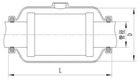
When a pipeline springs a leak, you have minutes to stop it — not days to order a custom fix. The right repair clamp seals the leak on the first try and keeps the line in service. The wrong one leaks again within weeks. Here’s how to choose correctly, in five decisions.
1. Match the pipe material first
Every repair clamp is designed for a specific family of pipe materials. Using a ductile iron clamp on a PE pipe (or vice versa) almost guarantees a failed repair.
- Ductile iron / grey cast iron: Use clamps with QT450-10 ductile iron shell and EPDM gasket. The rigid body grips the cast surface evenly.
- PE, PVC, PPR (plastic): Use plastic-rated clamps with longer gasket contact area — plastic pipes deform under clamp pressure, so the seal must accommodate creep.
- Concrete (self-stressed or pre-stressed): Use concrete-specific clamps with a larger inner diameter and thicker gasket — concrete surfaces are rough and uneven.
- Galvanized steel: Thin-wall galvanized pipes in gas/water systems need lower-torque clamps to avoid crushing the pipe.
- Steel: Heavy-wall steel pipe clamps are rated for higher pressure (1.6 MPa+) and use wider bolt patterns.
2. Identify the leak location
Where the leak is on the pipe determines the clamp geometry:
| Leak Location | Clamp Type |
|---|---|
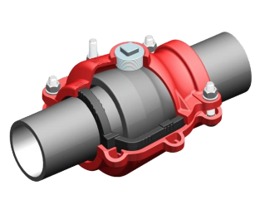
| Socket joint (承插口) | Socket repair clamp — wraps the bell + spigot |
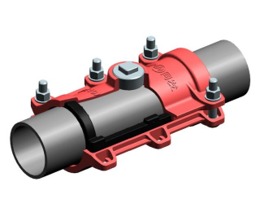
| Straight pipe mid-section | Straight pipe repair clamp |
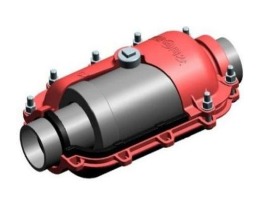
| Sleeve joint (套袖) | Sleeve repair clamp |
| Reverse-flared joint | Reverse repair clamp |
| Flange joint | Flange repair clamp |
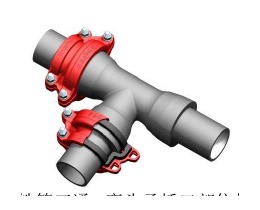
| Tee branch | Tee repair clamp (equal or reducing) |
| Elbow 45° or 90° | Elbow repair clamp |
If you guess wrong here, the clamp won’t close flush around the leak and will drip.
3. Measure the outer diameter — not the nominal DN
Nominal DN is a rough label. DN100 pipe from one manufacturer may measure 118mm OD; another 122mm. Repair clamps are sized to actual OD, not DN. Always measure with calipers before ordering.
For plastic pipes this is critical — OD varies by standard (ISO vs. GB). A 110mm OD PE and a 114mm OD PE look identical but use different clamps.
4. Pick the pressure rating
Two tiers cover most water and gas applications:
- Standard (1.0 MPa): municipal water, low-pressure gas, fire protection mains
- High-config (1.6 MPa): industrial water, chilled water, elevated gas pressure
If you’re repairing a line rated above 1.6 MPa, you need custom-engineered clamps — not an off-the-shelf stock item.
5. Don’t forget seal material
- EPDM: default for water, 1.0/1.6 MPa. Safe with potable water. Temp range −30°C to +120°C.
- NBR: required for gas, oil, diesel, most hydrocarbons. Not for potable water in most jurisdictions.
- FKM (Viton): high-temp chemical applications.
Using EPDM on a natural gas line is a code violation in most countries. Always specify NBR for gas.
Final checklist before ordering
- Pipe material (DI, steel, PE, PVC, PPR, concrete, galvanized)
- Measured outer diameter (mm, with calipers)
- Leak location (socket / straight / sleeve / tee / elbow / flange)
- System pressure (MPa)
- Fluid (water, gas, oil, chemical)
- Temperature range
- Quantity + lead time
Send this list when you contact our sales team — we’ll size the clamp in under an hour.