High-density polyethylene (HDPE) has become one of the dominant pipe materials for water distribution and gas distribution globally. Its advantages are significant: it is corrosion-proof, flexible enough to survive ground movement, and weldable using electrofusion or butt fusion without fittings. But HDPE is not without failure modes, and when an HDPE main fails in service, the mechanical repair options are meaningfully different from those used on iron or steel pipe.
This article covers the specific considerations for applying mechanical repair clamps to HDPE and PE (polyethylene) pipelines — including why standard ductile iron clamp designs need to be adapted, what OD tolerance issues arise, and how to permanently repair an HDPE main without electrofusion equipment.
How HDPE fails differently from iron pipe
Iron and steel pipes fail primarily by corrosion — electrochemical attack from soil, water chemistry, or stray current creates pinholes, wall thinning, and eventually breaches. HDPE cannot corrode in this way.
HDPE pipe failures typically arise from:
Mechanical damage: Third-party strikes during excavation are the most common cause of HDPE pipe failure in service. A backhoe bucket cuts or squashes the pipe. The damage is usually localised to a short section.
Joint failure: Electrofusion couplings and saddle tees that were not properly prepared (inadequate scraping of the PE surface, contamination during fusion) develop leak paths years after installation as thermal cycling works on a poor bond.
UV degradation: Unburied HDPE pipe exposed to sunlight without UV stabiliser content will become brittle and crack longitudinally over time. This is uncommon in buried service but relevant for above-ground pipe.
Long-term slow crack growth: Under sustained tensile stress — typically from poor installation with backfill that creates point loading — HDPE can develop slow crack growth (SCG) failures. These appear as fine longitudinal cracks in the pipe wall, often without the dramatic rupture that iron pipe failures produce.
Squeeze-off damage: When an HDPE gas main is shut off using a squeeze-off tool (the standard field isolation technique), improper procedure or using a tool not matched to the pipe SDR ratio can create a damaged zone that later cracks.
Why standard iron-pipe clamps don’t work on HDPE
The core problem is compressibility. HDPE is a semi-crystalline thermoplastic with a modulus of elasticity of approximately 800–1,000 MPa at room temperature, compared to approximately 170,000 MPa for ductile iron. When you bolt a rigid iron clamp around an HDPE pipe and tighten to standard torque, two things happen:
-
The pipe ovulates: The bolt load compresses the pipe cross-section from circular to slightly elliptical. In a metal pipe, this force creates gasket compression and sealing. In HDPE, the pipe itself deforms, and the bolt load is partially absorbed by pipe deformation rather than gasket compression.
-
Stress relaxation (creep): HDPE under sustained mechanical stress will gradually deform (creep) until the stress is relieved. A clamp torqued to 80 N·m today may be effectively at 40 N·m six months later, as the HDPE has slowly deformed and the compressed gasket has returned to its uncompressed state. The clamp will leak.
Standard ductile iron repair clamps designed for iron and steel pipe are not acceptable for HDPE without design modifications that address both issues.
Design features required for HDPE-compatible repair clamps
A repair clamp designed for HDPE service must incorporate:
Wide-profile, low-modulus gasket
An HDPE-compatible gasket uses a wider and softer EPDM profile than a standard iron-pipe gasket. The wider contact zone distributes the sealing force over a larger pipe OD area, reducing the peak contact stress and reducing pipe ovulation. A Shore A hardness of 45–50 is typical for HDPE gaskets, versus 55–65 for the standard gaskets used on iron and steel.
Controlled bolt torque limits
The torque specification for an HDPE clamp is substantially lower than for the equivalent iron-pipe clamp. This is not a quality issue — it is the correct design. Overtorquing an HDPE clamp causes pipe deformation and defeats the sealing function. Follow the manufacturer’s torque table for the specific SDR (standard dimension ratio) of your pipe.
OD tolerance accommodation
HDPE pipe is manufactured to an OD tolerance that is tighter than iron pipe but variable by SDR and manufacturer. A PE100 pipe of DN200 SDR17 has a nominal OD of 200 mm, with typical manufacturing tolerance of ±1.0 mm. However, over years of service, HDPE can be slightly flattened by overburden or by squeeze-off events. Measure the actual OD at the repair site with a circumference tape.
Key issue: the same nominal DN of HDPE has a different OD than iron pipe. DN200 HDPE has an OD of 200 mm. DN200 ductile iron has an OD of 222 mm. A clamp specified as “DN200” for iron pipe will not fit the HDPE pipe — and vice versa. Always specify repair clamps for HDPE by actual OD, not by DN.
Shell rigidity or stiffening plates
Some designs use a slightly thicker shell or add internal stiffening ribs to resist the tendency to create a concentrated load at the bolt bosses. The load must be distributed uniformly around the pipe circumference to achieve even gasket compression on a compliant substrate.
Product options for HDPE pipe repair
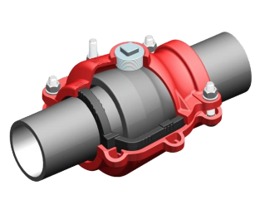
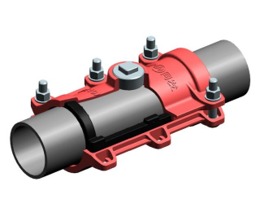
1. Universal repair clamp with HDPE gasket
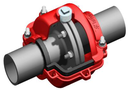
A universal repair clamp is a standard split-sleeve design with an OD accommodation range wide enough to serve as a “universal” fitting across multiple pipe materials. The shell is ductile iron; the gasket is a wide-profile EPDM compound suited to the lower modulus of HDPE.
Best for: Single pinholes or small cracks in HDPE distribution mains, DN100–DN400.
Limitation: These are designed for low-to-medium operating pressures. For HDPE gas mains above 0.5 MPa operating pressure, confirm the clamp is rated and test to 1.5× operating pressure after installation.
2. Stainless steel repair band clamp
A band clamp (also called a repair band or stainless repair sleeve) uses a continuous stainless steel band wrapped around the pipe and a single wide EPDM gasket. The band can accommodate slight OD variations and applies a distributed clamping force rather than a concentrated bolt-boss load.
Best for: Above-ground HDPE pipework in industrial applications, corrosive environments (where SS316 is preferred), and applications requiring frequent access (the band design is faster to remove and reinstall than a bolted shell clamp).
Limitation: Band clamps are not suitable for high-torque applications or where the pipe OD is significantly out of round.
3. Electrofusion saddle clamp for tapping and small repairs
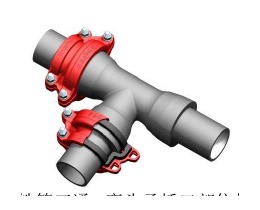
If the damage is a failed electrofusion saddle joint or a small pinhole adjacent to a tee fitting, an electrofusion saddle repair piece is the cleanest solution — it welds to the HDPE pipe surface and creates a molecular bond, not just a mechanical seal. But it requires electrofusion equipment and skilled operators, and the pipe must be isolated and depressurized for the fusion cure time (typically 30–90 minutes depending on ambient temperature).
Best for: Situations where the pipeline can be isolated (even temporarily) and where the repair crew has electrofusion equipment and training.
Limitation: Cannot be used on pressurised live pipes. Not suitable for emergency live-line repair.
4. Mechanical couplings for section replacement
When the damaged HDPE section must be cut out (for example, a backhoe-strike that has crushed 600 mm of pipe), the repair approach is:
- Cut out the damaged section
- Insert a straight HDPE spool piece cut to length
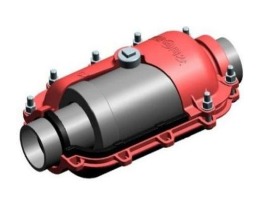
- Join each end with a universal coupling rated for HDPE OD
The universal coupling is specified by OD, with gaskets rated for the fluid service. For PE100 at 0.4 MPa potable water service, this is a standard EPDM coupling. For gas service, specify NBR gaskets (for petroleum gases) or confirm EPDM compatibility with the gas composition.
Installation procedure for HDPE repair clamps
The procedure differs from iron-pipe clamp installation primarily in the torque limits and inspection steps.
Surface preparation: Clean the HDPE surface with a clean cloth and isopropyl alcohol or a compatible PE surface cleaner. Do not use petroleum-based solvents — these can swell or soften HDPE. Do not sand or grind the HDPE surface unless specifically required by the gasket manufacturer; the natural smooth surface of PE is actually preferable for sealing.
OD measurement: Measure the pipe OD with a circumference tape. Note whether the pipe is round (check at two orthogonal points). If the pipe is more than 2% out-of-round (which can happen with old pipe or after squeeze-off), the gasket may not seat uniformly and a wider-profile gasket clamp may be needed.
Clamp positioning: Centre the clamp over the defect with at least 75 mm of gasket overlap on each side of the defect. For a circumferential crack at an electrofusion coupler, centre the clamp over the entire coupler zone.
Torquing: Follow the manufacturer’s table exactly. For most DN200 HDPE repair clamps, this is in the range of 25–50 N·m — significantly less than the 100+ N·m used for iron pipe. Tighten in a crossing pattern, in three stages (30%, 60%, 100% of target).
Check for pipe ovulation: After tightening to specification, run a hand around the pipe at both ends of the clamp. Slight ovulation (up to approximately 1%) is acceptable. Visible deformation into an ellipse means you have overtightened or the pipe wall is compromised — back off the bolts, inspect the pipe wall, and re-torque.
Post-installation observation: Observe the installed clamp for 15 minutes at operating pressure. Any seepage at the gasket edge indicates: incorrect OD (measure again), gasket incorrectly seated (remove and reinstall), or pipe OD significantly out-of-round. Do not simply add torque without investigating the cause.
HDPE-specific installation cautions
Temperature effects: HDPE has a relatively high coefficient of thermal expansion (approximately 200 × 10⁻⁶ /°C, versus 12 × 10⁻⁶ /°C for steel). In outdoor installations, a pipe exposed to direct sun can heat significantly during the day and cool at night. This thermal cycling causes the pipe OD to change by approximately 0.2–0.4 mm per 10°C per metre of diameter — which will work on the gasket seal of a mechanical clamp. For above-ground HDPE installations in hot climates, specify a repair clamp with a wide-lip gasket design that accommodates OD movement, or shade/insulate the pipe section to reduce temperature cycling.
Pressure surges: HDPE is more susceptible to fatigue from pressure surges than steel or iron. If the system experiences water hammer (from pump starts/stops or rapid valve closures), evaluate the peak surge pressure, not just the MAOP, when specifying the clamp pressure rating.
Chemical compatibility: Standard EPDM gaskets are compatible with potable water, natural gas, and most municipal wastewater applications. For industrial process fluids, always confirm EPDM compatibility with the specific fluid chemistry.
SDR specification and wall thickness
When ordering HDPE repair clamps, the pipe SDR is useful but the OD is the critical dimension. SDR (standard dimension ratio) defines the wall thickness relative to the OD: SDR17 means OD/wall = 17, so a DN200 SDR17 pipe has a wall of 200/17 = 11.8 mm. The wall thickness affects how much the pipe can deform under clamping load — thicker walls (lower SDR) deform less and are easier to clamp.
As a general guideline: SDR11 and SDR13.6 HDPE (commonly used for gas distribution) are thicker-walled and less susceptible to ovulation under clamping load. SDR17, SDR21, and SDR26 (thinner-walled, used for lower-pressure water distribution) require more careful attention to torque limits.
PipeKnot supplies universal repair clamps with HDPE-compatible wide-profile EPDM gaskets for OD ranges from 40 mm to 630 mm. We also supply universal couplings for HDPE section replacement from DN40 to DN630. For larger HDPE mains (above DN630), contact us for custom-specification options. Provide your pipe OD (measured), SDR, fluid type, and operating pressure and we will specify the correct product.